
THE EXPEDITION REPORT / PLAY REALM GUIDE
Mini Metro
A beautifully legible capacity puzzle that turns a handful of lines and symbols into a demanding transport system.
Game facts
- Developer
- Dinosaur Polo Club
- Publisher
- Dinosaur Polo Club
- Released
- 6 November 2015
- Platforms
- Windows · macOS · Linux (Steam edition)
- Model
- Paid game
- PEGI
- 3 — Nintendo Switch edition; not a separate PC classification
- Players
- Single-player
- Length
- Short
- Difficulty
- 3 / 5 · Moderate
- Steam Deck
- Verified
PEGI source ↗ · Steam Deck status source ↗
Edition: Base game
The score, explained
The interest and responsiveness of the core decisions and actions.
How progression, exploration and goals fit together.
The coherence of the visual, musical and narrative presentation.
How clearly the game explains its rules and offers useful ways to engage.
The depth of optional goals, alternative approaches and reasons to return.
Read the city as a flow of passengers
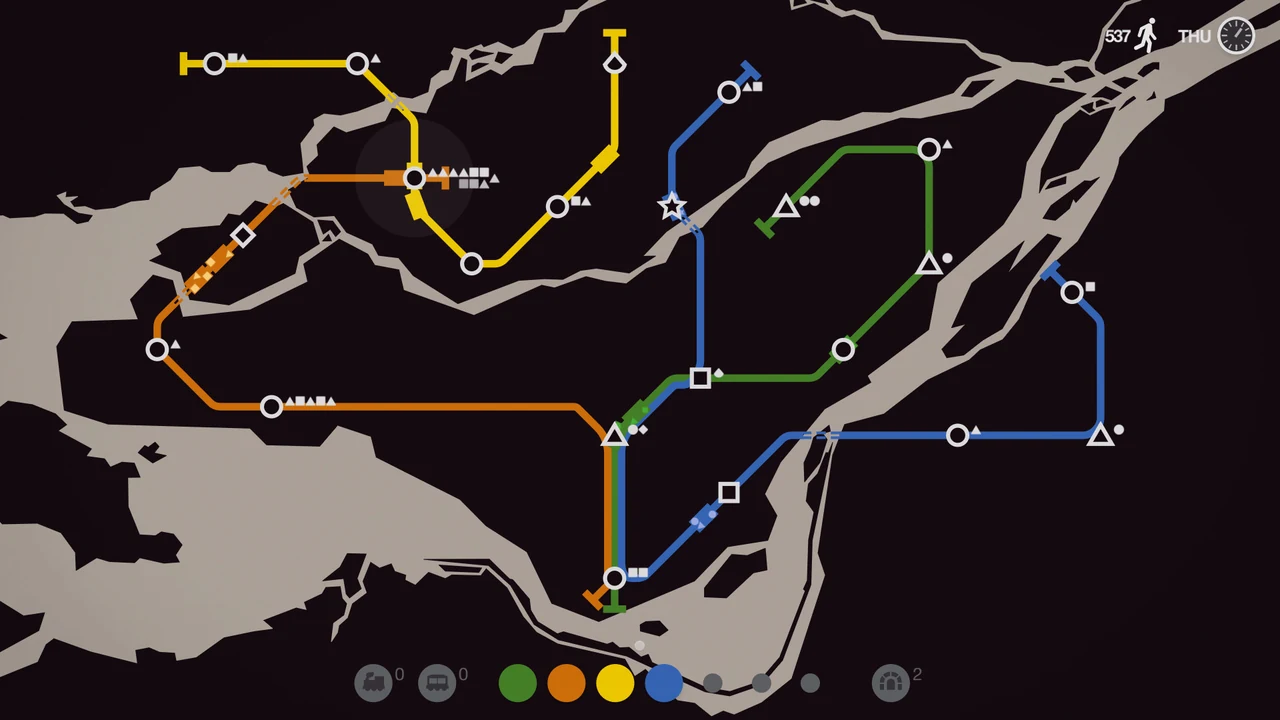
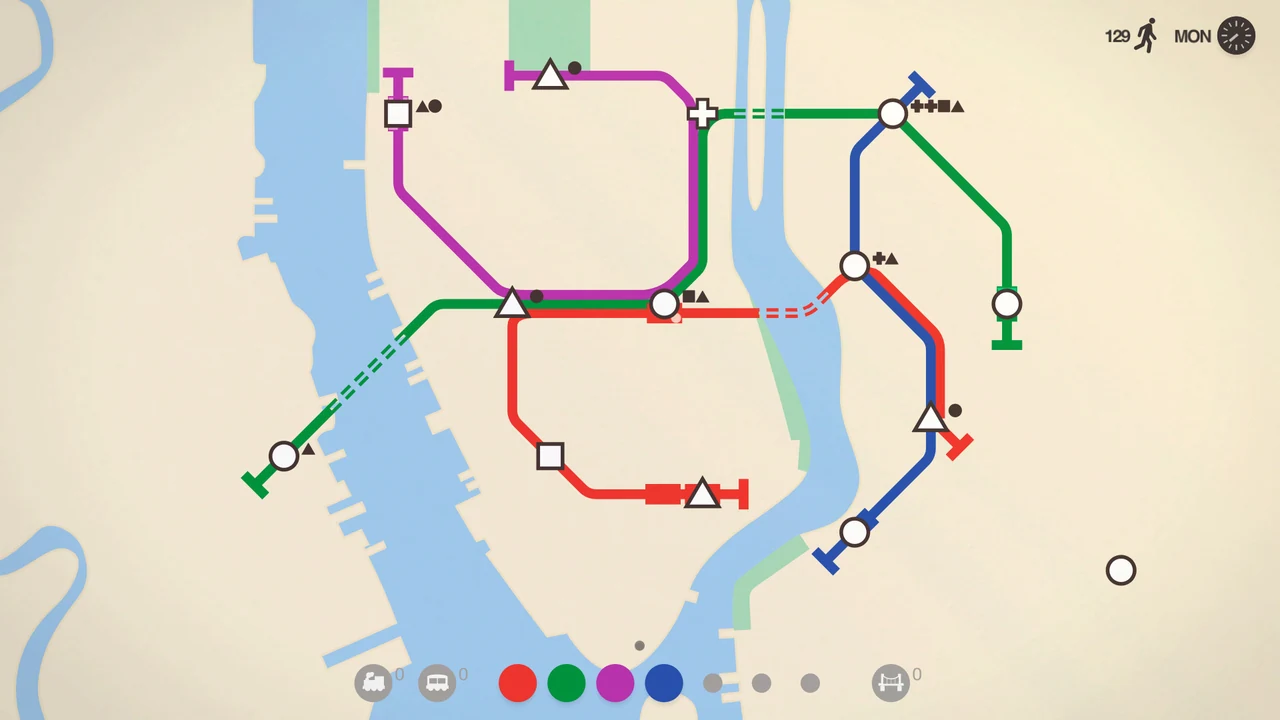
Mini Metro turns a growing city into stations, lines and passengers with destinations represented by shapes. That abstraction makes the first problem easy to understand: connect places so people can reach the type of station they need. The difficulty arrives when several journeys share the same limited trains and track arrangement. A line that looks elegant can become inefficient once passengers accumulate at a busy interchange. The opening therefore encourages observation as much as construction. You need to notice which station is filling, where transfers occur and whether a train is carrying passengers past a useful connection. For this guide, the appeal is a transport strategy game that makes its important relationships visible without demanding a large amount of technical knowledge before the first useful decision.
Resources turn a map into a set of trade-offs
New lines, locomotives, carriages and tunnels offer different answers to pressure. Adding capacity to an existing route may help more than drawing another connection, while a new interchange can redistribute journeys across several lines. Rivers and other geographic constraints make crossing resources especially valuable. The useful question is not whether every station has a line through it, but whether the arrangement gives passengers practical paths without overloading a few critical points. Because the available upgrades are limited, each decision commits the network to a particular approach. The game makes those commitments easy to inspect. You can see a queue shrink after a successful change, or discover that solving one crowded station has simply moved the problem to the next interchange.
Expansion keeps the system unsettled
The network never stays complete for long. New stations appear in places that can disturb a sensible arrangement, and rising demand eventually exposes weaknesses that were harmless earlier. That constant pressure is exciting if you enjoy adaptation, but it can frustrate players who mainly want to create a finished, efficient map. The clean visual language also means that the city exists largely through its flows rather than through detailed neighbourhoods or individual stories. A failure is a transport problem, not a dramatic civic event. Mini Metro asks you to find satisfaction in the behaviour of a system. If the attraction of city building is decoration, long-term ownership or a rich simulation of residents, this is a much narrower and more abstract experience.
Choose it for a compact strategic language
Mini Metro's strength is how much it expresses with a small set of symbols. Different city maps change the geography and constraints, but the central task remains clear enough to support immediate experimentation. You can begin with a plausible network, watch it operate and revise it without navigating a dense collection of menus. That makes it a strong recommendation for players who enjoy spatial planning and visible feedback. It also pairs well with the more road-focused Mini Motorways, which turns similar pressures into individual vehicle movement. Choose Mini Metro when you want the cleaner abstraction of lines, transfers and capacity. The reward is the moment a revised arrangement makes a crowded system intelligible again, even though the next station will soon ask another question.
The verdict
A beautifully legible capacity puzzle that turns a handful of lines and symbols into a demanding transport system.
Reasons to play
- Passenger flows provide immediate feedback
- Upgrades offer genuinely different solutions
- City geography creates distinct constraints
Reasons to think twice
- Expansion continually unsettles the network
- Abstract presentation offers little civic detail
See the game
Assist & accessibility
Explore the available settings and control options on the official game page before choosing your setup.
Parents’ guide
Players: Single-player. No in-game purchase marker in the checked Steam listing. Separate downloadable content may be sold.
Age classification: 3. Nintendo Switch edition; not a separate PC classification
A useful starting tip
Investigate the cause of a crowded station before adding another long line; an awkward transfer can be more important than raw capacity.
A different direction
Compare this with Mini Motorways: An accessible transport problem with enough moving consequences to make every useful road revision satisfying.
Official sources
Reviewed: November 2026
You might also like
 BalatroRead review →
 Into the BreachRead review →
 Slay the SpireRead review →