
THE EXPEDITION REPORT / PLAY REALM GUIDE
Mini Motorways
An accessible transport problem with enough moving consequences to make every useful road revision satisfying.
Game facts
- Developer
- Dinosaur Polo Club
- Publisher
- Dinosaur Polo Club
- Released
- 20 July 2021
- Platforms
- Windows · macOS (Steam edition)
- Model
- Paid game
- PEGI
- 3 — Nintendo Switch edition; not a separate PC classification
- Players
- Single-player
- Length
- Short
- Difficulty
- 3 / 5 · Moderate
- Steam Deck
- Verified
PEGI source ↗ · Steam Deck status source ↗
Edition: Base game
The score, explained
The interest and responsiveness of the core decisions and actions.
How progression, exploration and goals fit together.
The coherence of the visual, musical and narrative presentation.
How clearly the game explains its rules and offers useful ways to engage.
The depth of optional goals, alternative approaches and reasons to return.
Draw a network that can still change
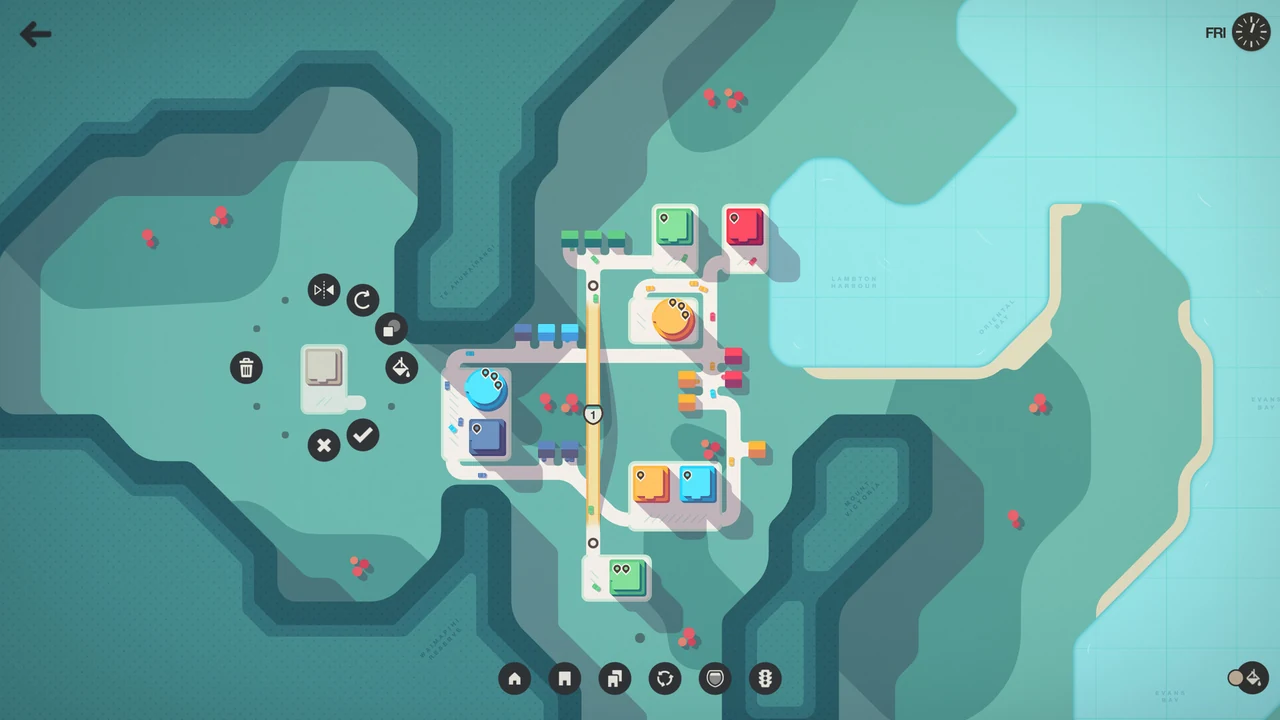
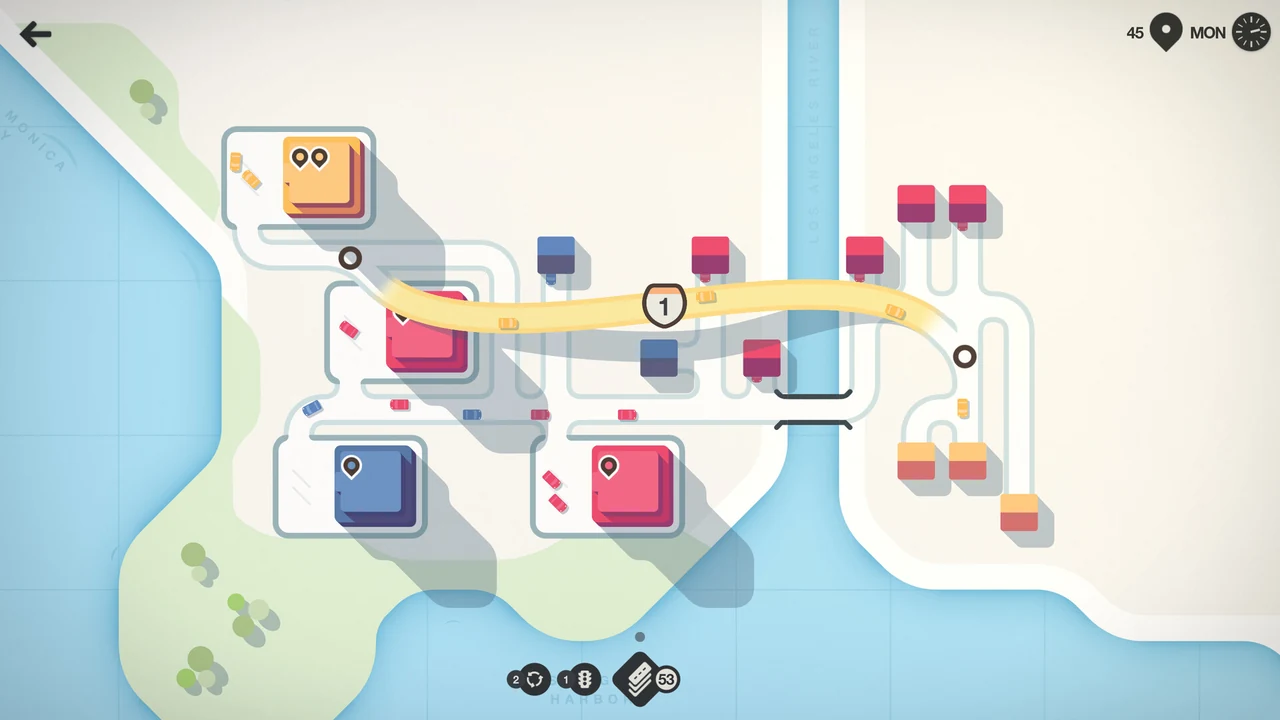
Mini Motorways begins with a small promise: connect houses to destinations and let the cars make their journeys. The difficulty comes from growth. New buildings appear, demand increases and a road that initially seemed convenient can become a source of congestion. Because houses and destinations have colours, the network must solve several overlapping journeys rather than one simple route. The first decisions therefore deserve more thought than the spare presentation might suggest. A crossing or connection can affect traffic elsewhere, and limited road pieces make every detour meaningful. This is a strong opening for players who enjoy spatial strategy. You can understand the basic objective immediately, then spend the rest of the session discovering the consequences of the lines you chose to draw.
Capacity matters as much as connection
A destination being reachable does not mean the network can serve it comfortably. Cars need enough room to move, and several routes meeting at one junction can interfere with one another. Bridges, tunnels, motorways and roundabouts create different ways to handle geography and pressure, but their limited supply forces choices. A motorway can solve an important long-distance journey while leaving a local bottleneck untouched. The useful strategic habit is to watch where vehicles hesitate and ask which shared section is carrying too many demands. The game rewards that practical diagnosis. Its network is not just a diagram that looks organised; it is a working system whose performance reveals whether the arrangement of roads actually matches the pattern of journeys being made.
Growth can make a tidy plan obsolete
New buildings do not wait for an ideal network, so a carefully separated arrangement can suddenly need a connection in an awkward place. Limited weekly upgrades mean that the tool you want may not be the one available. That uncertainty gives the game energy, but it also means a loss can feel partly shaped by circumstances outside your control. Redesigning a busy network requires patience because cars already travelling continue to matter. Players who want a construction game with a stable final layout may find this relentless growth uncomfortable. The pleasure lies in maintaining a workable arrangement for as long as possible, not in reaching a permanent state where the map is finished and every future demand has already been solved.
A clear choice for spatial problem solving
Mini Motorways suits players who like to see an abstract decision become visible movement. A small road change can alter traffic across a neighbourhood, making the effect of a successful intervention easy to understand. Different city maps bring geographic constraints that change how the same tools are used. The restrained visual language keeps attention on those relationships, while the increasing demand gives a session a clear arc of pressure. Choose it when drawing, observing and revising a network sounds satisfying. Readers who want detailed economic simulation or a story-led city should look elsewhere. This game's strength is its concentration: a few tools, a growing map and a repeated invitation to make the next journey work more smoothly than the last one.
The verdict
An accessible transport problem with enough moving consequences to make every useful road revision satisfying.
Reasons to play
- Traffic makes bottlenecks visible
- Limited upgrades create clear trade-offs
- Geography changes how tools are used
Reasons to think twice
- Unexpected growth can disrupt a sound layout
- The network never reaches a permanent finished state
See the game
Assist & accessibility
Explore the available settings and control options on the official game page before choosing your setup.
Parents’ guide
Players: Single-player. No in-game purchase marker in the checked Steam listing. Separate downloadable content may be sold.
Age classification: 3. Nintendo Switch edition; not a separate PC classification
A useful starting tip
Look at where traffic converges before extending a road; a convenient connection now can create a bottleneck as the city grows.
A different direction
Compare this with Mini Metro: A beautifully legible capacity puzzle that turns a handful of lines and symbols into a demanding transport system.
Official sources
Reviewed: November 2026
You might also like
 BalatroRead review →
 Into the BreachRead review →
 Slay the SpireRead review →